Pages

Showing posts with label research. Show all posts

Wednesday, February 22, 2023

Living in Australia web survey

Multicultural Marketing & Management (MMM) invites males of Islam faith to participate in a paid web survey about living in Australia. The web survey is for males aged 16-34 years old and living in Australia. The research is conducted on behalf of an Australian client.  

The web survey is about 15 minutes, in English and we pay $10 supermarket e-gift card afterwards to thank those who complete the survey successfully (Payment will be made within two weeks, sent via our email admin(at)multiculture.com.au). The information collected will be treated in the strictest confidence. Your answers will not be associated with your personal detail. The result of the survey will be published in aggregates only. 

The survey is on a first-come-first-serve basis. Please only participate once. Please enter your email address and postcode below. Then you will be taken to the survey web page.


Email *      

Postcode *
 

Monday, November 28, 2022

Korean speakers required for Asian media web survey


Multicultural Marketing & Management (MMM) invites Korean people to participate in a paid web survey about Asian media. The web survey is for those living in Australia. The research is conducted on behalf of an Australian client. 

The web survey is about 15 minutes, in English and we pay $10 supermarket e-gift card afterwards to thank those who complete the survey successfully (within two weeks). The information collected will be treated in the strictest confidence. Your answers will not be associated with your personal detail. The result of the survey will be published in aggregates only. 

The survey is on a first-come-first-serve basis. Please only participate once. Please enter your email address and postcode below. Then you will be taken to the survey web page. 

MMM(Multicultural Marketing & Management)은 아시아 미디어에 대한 유료 웹 설문조사에 한국 사람들을 초대합니다. 웹 설문조사는 호주에 거주하는 사람들을 위한 것입니다. 이 연구는 호주 클라이언트를 대신하여 수행됩니다.

웹 설문조사는 영어로 약 15분 동안 진행되며 설문조사를 성공적으로 완료(2주 이내)한 분들께 감사의 의미로 $10 슈퍼마켓 e-기프트 카드를 지급합니다. 수집된 정보는 가장 엄격한 기밀로 취급됩니다. 귀하의 답변은 귀하의 개인 정보와 연결되지 않습니다. 설문조사 결과는 집계로만 게시됩니다.

설문조사는 선착순입니다. 한 번만 참여해주세요. 아래에 이메일 주소와 우편번호를 입력하세요. 그러면 설문조사 웹페이지로 이동하게 됩니다.

Saturday, October 8, 2022

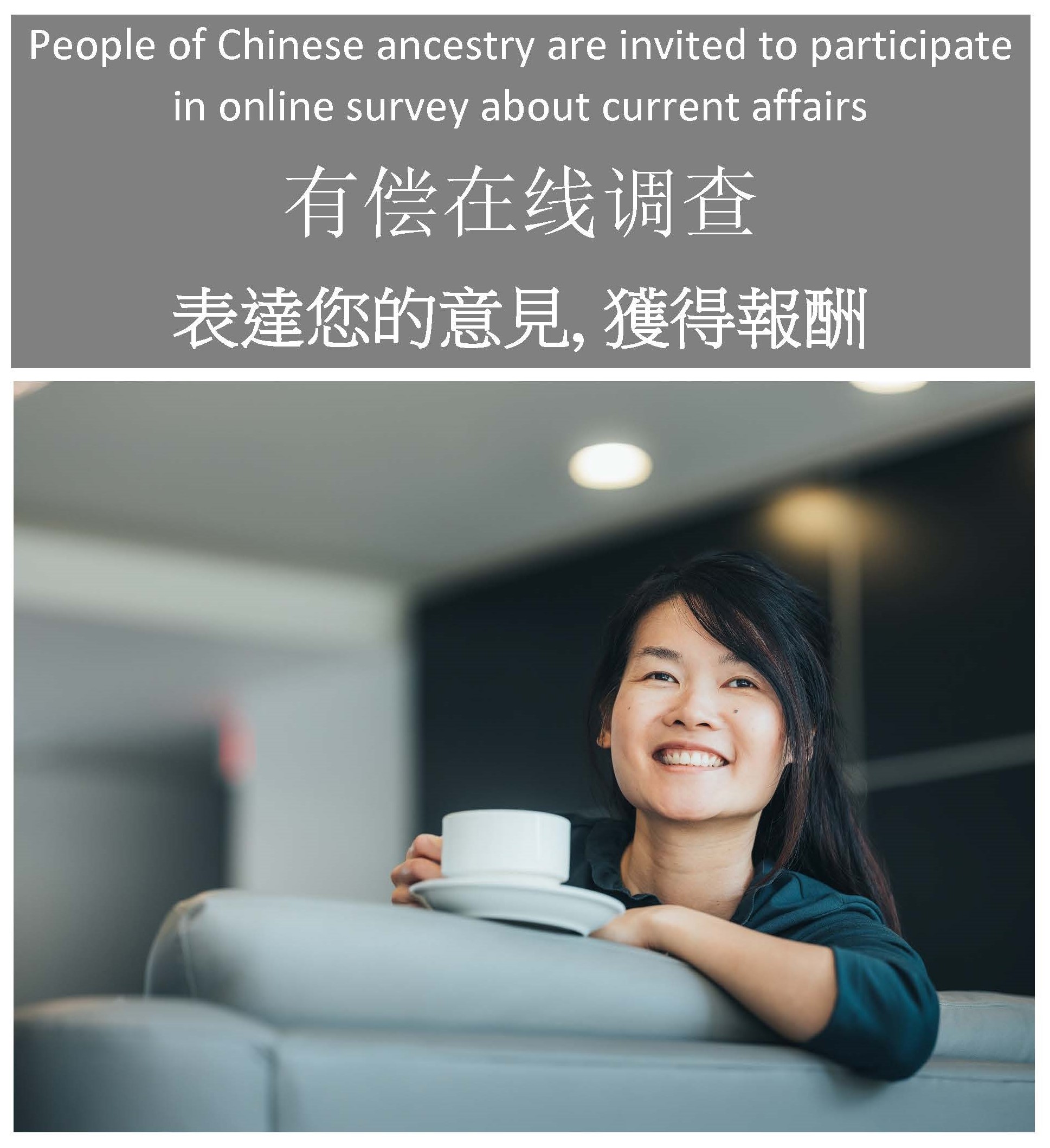
People of Chinese ancestry are invited to participate in online survey about current affairs

Paid online survey - We invite people of Chinese ancestry in Australia to participate in a paid online survey about current affairs issues. We pay $10 after to thank the respondents. 

Survey will take about 15 minutes and is in English, simplified and traditional Chinese. 

If you are interested, please email admin(at)multiculture.com.au with a) your name, b) country of birth, c) language and d) postcode. Australian born Chinese are welcome to participate too. Your opinion is important to shape our client's strategy. 

Please put "FBChin" on the subject line. Multicultural Marketing and Management is a research agency established in 1993.

有偿在线调查 - 我们邀请在澳大利亚的华裔人士参加关于时事问题的有偿在线调查。 调查大约15 分钟,我们支付 $10 感谢参与者。调查以英文、简体中文或者繁体中文进行。

如果您有兴趣,请发送电子邮件至 admin(at)multiculture.com.au,并附上a) 您的姓名、b) 出生国家、c) 语言和 d) 邮政编码。 澳大利亚出生的华人也欢迎参加。 您的意见对于我们客户制定策略很重要。

请在电邮主题行写“FBChin”。 Multicultural Marketing & Management 是一家成立于 1993 年的研究机构。

我們邀請在澳洲的華裔人士參加關於時事問題的在線調查。調查大約15 分鐘,我們支付 $10 感謝參與者。調查以英文、簡體中文或者繁體中文進行。

如果您有興趣,請發送電子郵件至 admin(at)multiculture.com.au,並附上a) 您的姓名、b) 出生國家、c) 語言和d) 郵政編碼。澳洲出生的華人也歡迎參加。您的意見對於我們客戶制定策略很重要。

請在電郵主題行寫“FBChin”。 Multicultural Marketing & Management 是一家成立於 1993 年的研究機構。

Thursday, September 8, 2022

Paid online web survey - Filipino speakers in Australia

Paid online survey - We invite Filipino speakers in Australia to participate in a paid online survey about current affairs issues. We pay $10 after to thank the respondents. 

Survey will take about 15 minutes and is in English. 

If you are interested, please email admin(at)multiculture.com.au with your contact detail, language and postcode. Please put "FBFC" on the subject line. Multicultural Marketing and Management is a research agency established in 1993.


Saturday, August 27, 2022

Paid research about Ageing - Arabic and Chinese participants

We are looking for Arabic and Chinese participants over 50 years old, living in Australia to attend one-on-one online interview. The interview will be around one hour based on agreed date and time. We pay $100 to thank the participants. The research is conducted for an education institute in Australia. Detail is as below:- 

Topic: About ageing and wellbeing.

Online interview (for over 50 years old participants)

Monday 29 Aug 2022 to Friday 2 SEP 2022, (during business hour)

via Microsoft Teams - you must use a laptop or tablet, not mobile phone, to participate. 

And you speak Chinese or Arabic at home.

If you are interested, please email your contact detail, language, age and postcode to admin(at)multiculture.com.au 

Please write "AFB" on the subject line.


Paid research about social issues

Chinese-speakers in Australia are invited to attend paid research about social issues. We pay $100 to thank the participants after.

Format - online, in English
1. Six discussion groups (two in-language), 2 hours, from 5-8 September, evening,
2. One-on-one interviews, 1 hour, at agreed date and time (office hours)

我们邀请住在澳大利亚的华人参加有关社会问题的研究。之后我们支付 $100 来感谢参与者。
我們邀請住在澳洲的華人參加有關社會問題的研究。 之後我們支付 $100 來感謝參與者。

In English, participants will be grouped by age and country of birth.
GP1, WED, 7 Sep 6:30pm-8:30pm
GP2, MON, 5 Sep, 6:30pm-8:30pm
GP3, TUE, 6 Sep, 6:30pm-8:30pm
GP4, THU, 8 Sep, 6:30pm-8:30pm
GP5, WED, 7 Sep, 6:30pm-8:30pm, Mandarin speakers 讲普通话的华人, 以普通话进行。
GP6, TUE, 6 Sep, 6:30pm-8:30pm, Cantonese speakers 講廣東話的華人, 以廣東話進行。

B. 一对一研究访谈,1小时,在线,以英语进行,在约定的日期和时间(办公时间)(仅适用于澳大利亚公民)- For China-born Australian citizen only. 

If you are interested, email your contact detail, age, gender, country of birth, and postcode to admin(at)multiculture.com.au. Please put "TPFM" on the subject line. Thank you.

如果您有兴趣,请将您的联系方式、年龄、性别、出生国家和邮政编码发送至
如果您有興趣,請將您的聯繫方式、年齡、性別、出生國家和郵政編碼發送至 admin(at)multiculture.com.au。 

请在主题行加上“TPFM”。谢谢你。
請在主題行加上“TPFM”。 謝謝你。


Thursday, July 28, 2022

Food purchasing behaviour research - Indian participants

Indian people invited to participate in research about food purchasing behaviour. We are looking for participants of Indian ancestry to attend 90 minutes or 2-hour discussion groups. After completing the discussion, participants will be paid $90 or $120 to thank them for their time. Detail at below:-   

Topic: Food purchase behaviour

For participants from Sydney - Location: Parramatta, face-to-face, $120

G3- Female group (with children) - 9 Aug 2022, TUE, 6:30-8:30pm


For participants from Melbourne - Online, $90

G6- Female group (without children) - 10 Aug 2022, WED, 6-7:30pm

G4- Male group (with children) - 9 Aug 2022, TUE, 6-7:30 pm;


Participants from any state - Online, $90

G5 - Male group (with children, newly settled in Australia)10 Aug 2022, WED, 6-7:30pm

If you are interested, please email your contact detail, age, gender and postcode to admin(at)multiculture.com.au


Wednesday, March 23, 2022

Paid research about mental health services

Multicultural people are invited to participate in a research about mental health services for a government department. We are looking for CALD participants living in Australia to attend face-to-face/ online focus group discussions (1.5 hours) or one-on-one interview (1 hour). After completing the discussion/interview, we will pay $100/$80 to thank the participants. Detail is as below:-


A. Group discussions (Face-to-face, for participants from Melbourne)
Date: 6 April 2022, Wednesday
Time: 6:00 - 7:30pm
incentive: $100

B. Group discussions (Online, for participants from other States)
Date: 6 April 2022, Wednesday
Time: 6:30 - 8:00pm Sydney time
incentive: $100

C. One-on-one interviews
One hour, from 4-8 April, at agreed time.
incentive: $80

Melbourne interviews will be face-to-face; other States - online

If you are interested, please email your contact detail, language you speak at home, gender and postcode to admin(at)multiculture.com.au


Monday, February 21, 2022

Paid research about cultural identity

People of Chinese ancestry are invited to attend online discussion groups. After completing the discussion (1.5 hours), the client will pay $80 to thank you for your time. The project is conducted for a cultural organisation. 


Topic – cultural identity


G1 - Mandarin Group: Thursday, 3 March, 6:30 - 8:00pm (Chinese born in Mainland China) 

G2 - Mandarin Group: Monday, 7 March,  6:30 - 8:00pm (Chinese NOT born in Mainland China)

G3 - Cantonese Group: Tuesday, 8 March,  6:30 - 8:00pm (for Cantonese speakers) 

G4 - English Group: Tuesday, 8 March,  6:30 - 8:00pm (second or third generation Chinese, i.e. you were born in Australia) 

If you are interested, please email your contact detail, country of birth, gender and postcode to admin(at)multiculture.com.au


Thursday, May 31, 2018

Is rock fishing more dangerous than other sport?

Is rock fishing more dangerous than other sport? The sea looked deceptively calm in some areas...


Friday, March 9, 2018

Changing faces of Parramatta

In November 2013, on behalf of the Parramatta City Council, MMM conducted over 600 street interviews with Church Street Mall shoppers. It is near some of the finest Asian restaurants on Church Street South (“Eat Street”), historic buildings, and a train station. Parramatta Town Hall and some nearby buildings are over 150 years old. Our research showed that shoppers wanted the area refurbished and physically changed.

It was opened in 2014 as Centenary Square.

Now a new civil building is being built in the area. Economic growth in Parramatta is estimated to jump to $30 billion by 2021.

Read more about the changing faces of Parramatta from:

Parramatta: Building a City of Dreams

Below are some old photographs taken back in 2014.


Wednesday, July 20, 2016

Ethical considerations in research data collection

There is a saying that "it doesn't hurt to ask." While that may often be true in casual conversation, asking questions as part of data collection is sometimes costly and has ethical considerations.

Is the data already available?

Census data is free. Okay, it's not exactly free, because your taxes pay for it – but anyone can get access to the statistical data. For example, if your business wants to know which neighbourhoods have dual-income households with no children, or the number of Indian-speaking households with teenagers in a specific suburb, that information is available from The Australian Bureau of Statistics (ABS), U.S. Census Bureau, UK Office for National Statistics, or other national Census office.  Sometimes you may need assistance in extracting the relevant data from Census data, but it is easier and less expensive than collecting data.

You might also be able to find relevant statistical data published by other sources, such as universities, chambers of commerce, and local governments.

What is the most efficient way to collect the data?

When you create a research plan, you need to determine the target sample size that is necessary. For example, if you want to research Martian immigrants in the USA, you would check the Census data to find that there are 950,000 Martians in the USA. You would aim for a sample of at least 600 participants. The sample size would produce a confidence level of 95% and a confidence interval of four.

A confidence interval of four means that if – for example – 57% of the survey participants pick an answer, you can be confident that if you had asked the question of the entire Martian population in the USA, between 53% (57- 4) and 61% (57 + 4) would have picked that answer.

When you put the confidence level and the confidence interval together, you can say that you are 95% sure that when 57% of our sample picks an answer, the true percentage of the entire Martian population in the USA who would have picked that answer is between 53% and 61%.

Depending on the type of data that you want, you might be able to collect data through online web surveys. Once you program the survey questions, your computers can tabulate the data automatically – it is just as easy to process 100 surveys as 9,000 surveys. Obviously, collecting data through one-on-one interviews and small focus groups is more costly and more intrusive, but those results can be combined with online survey results; for example, three focus groups, ten interviews, and 300 online surveys. This gives you valid data that is cost-effective. A mixed-methods approach also provides an advantage when exploring complex research questions. The qualitative data provides a deep understanding of survey responses, and statistical analysis offers a detailed assessment of patterns in responses.

Is it safe and ethical to collect the data?

There are types of research projects that have no ethical questions – for example, how many customers heard about the product from a specific advertising campaign.

Then there are projects have many ethical questions, such as:

  • If you thank research participants by giving them a small amount of cash or grocery store voucher, or free products, will that unduly influence the kind of answers they give?
  • Will our questions endanger or harm the participants, such as victims of people-smugglers, or survivors of institutional sexual abuse or spousal abuse? 
  • Do our questions give the participants false hope, such as expectations that completing an interview will get them a refugee visa?

There are some ethical considerations for which you have no doubts. For example, you may wish to observe an interview by using a one-way mirror from another room. If the participant has been guaranteed confidentiality, that would not be the right way to go about it. You could ask for a transcript of the interview, with identifying details redacted.

Standards

You can consider joining a professional research organisation -  such as Australian Market and Social Research Society (AMSRS) or U.S. Marketing Research Association  (MRA) and comply with their codes of professional standards, and with other relevant ethical standards for a project. Review all questions, participant criteria, and confidentiality procedures at the beginning of a project.

While you want to collect the data, you should never lose sight of the ethics involved.



Thursday, March 3, 2016

Summer Hill, Concord and Fairfield residents invited to participate in paid focus groups

Australia or overseas born homeowners in Sydney are invited to participate in the following paid focus groups:

Group 1:
Location of group: Parramatta
Date: Monday 14 March, from 6 - 7.30 pm
You are homeowners who live within Fairfield council areas

Group 3:
Location of group: City
Date: Thursday 17 March, from 6 – 7.30 pm
You are homeowners who live in Summer Hill (or within Ashfield Council areas), Concord (or within City of Canada Bay areas)

Topic: home repairs, bills, water usage
The focus group will be conducted in English
You live in the home you own (such as houses, townhouses, villas, NOT apartments)
We pay $80 per person to thank you for taking the time.

If you fit the criteria and are interested in participating, please send your name, phone number, age, suburb and country of birth to

admin (at) multiculture.com.au or SMS 0414 977 760

We are a professional research company with 23 years history.

Friday, September 18, 2015

Superannuation, migrants and the Swiss

Switzerland is a small landlocked nation with no natural resources except for water – and their ingenuity. Think of Swiss Army knives and Swiss watches. (We discussed our Swiss connection previously. You can check out the post about Roche Products, one of the world’s largest biotech companies by pressing here )

The Swiss are also famous for their banking and finance providers, with a long history of excellence and stability going back to the 13th century. Most likely, you and I don’t need a Swiss bank account, but we may be familiarised with their worldwide investment and superannuation services.

Zurich Financial Services has been in Australia since 1961, providing insurance products, property management, and investment and fund management services. They have more than 1,000 employees around Australia. They commissioned us to conduct multicultural research regarding their new superannuation products.

Researching new markets

Superannuation has been mandatory in Australia since 1992, but recent immigrants are unfamiliar with it. For example, mention “super fund” to someone from China and India, and you will get suspicious questions. While traditional Chinese and Indians are honour-bound to care for their aging family members, they have historically saved money on their own, with no employer contributions. They often distrust anyone who claims to be able to increase their funds for just a small fee. We’ve seen hostile attitudes even among college-educated computer professionals from other countries. Thus, reaching out to newer immigrants requires cultural skills and sensitivity.

We’ve also seen many persons who don’t want their superannuation funds invested in companies that conflict with their religious or ethical beliefs. For example, animal rights supporters may not want to invest in companies that do not treat their animals well, and Muslims and Jews might not want to invest in pork food products.

Now, how do you research these groups without being offensive?


  • First off, start by using native-born cultural consultants from migrant groups in order to develop questions for focus groups and surveys, wording them in culturally respectful ways. In some languages and cultures, using the wrong form of “you” can be disastrous.
  • Next, use experienced native-born researchers to lead focus groups and conduct interviews. The participants are more likely to be open with someone who is a fellow immigrant – for example, a fellow Muslim immigrant from Afghanistan, a Punjabi speaker from India, a Mandarin speaker from mainland China, and an Aramaic speaker for Syrian Christians. 
  • Lastly, have these cultural researchers assist in evaluating the research results, and write or review the reports and recommendations. They are bound to understand the nuances and needs of people from their own culture.


Often, a cultural group will have sub-groups. For example, Muslims can be divided into two main religious branches, Sunni and Shia – and also divided by countries, including the growing Australian Muslim community. There are two varieties of Aramaic spoken by Christians in Iraq, Turkey, Iran, and Syria, and many of them are seeking refuge in other countries. English-speakers in Singapore may speak standard English or “Singlish,” which is a mixture of English and other languages.

Australian laws require employees to have a minimum level of contributions to their super fund and requires employers (even small mom-and-pop businesses) to pay into a super product for employees. Therefore migrants need to understand this complex subject. While the government reaches out with general information, any company that wants superannuation business from migrants must reach out to them in their own language, using native-born consultants who know how to appeal to them.

In Australia, many adults who migrated here are trying to save for their own retirement and still take care of their aging parents, who are here or “back home” in China, India, etc. They are interested in investment information – if you speak to them.

Wednesday, August 12, 2015

Chinese migrants living in Western Sydney invited to participate in a paid research project

我们现邀请 Fairfield, Auburn 议会区内移民参加焦点小组讨论

主题:定居澳大利亚

讨论为期: 1. 5小时

付款方式: 我们支付每人50元


第10 – Auburn(奥本)议会区内移民,周五8月21日,下午6:30

第9组 – Fairfield(费尔菲尔德)议会区内移民,男,周六8月22日,上午11:30

第24组 - Auburn(奥本)议会区内移民,女,周六8月22日,下午2点


你必须是在中国,香港,台湾,马来西亚,新加坡等出生,并在1992年 - 2012年抵达澳大利亚 (不是海外学生)。如果您符合条件并有兴趣参与,请给我们发电子邮件:

admin (at) multiculture.com.au

你全名,白天电话号码,性别,郊区,年龄范围,我们会问你几个问题,看看你是不是适合此小组讨论。

我们是有二十年经验的市场研究公司。


Thursday, May 28, 2015

A research project that made us all hungry...

Everyone likes to eat, and most people like to talk about food – what to buy, where to shop, and how to cook it. But not everybody shops the same.

For example, most Australian shoppers like to buy fish that is pre-cut into fillets or steaks; the head and tail are gone, and the fish is cleaned. But Asian shoppers prefer whole fish so they can examine the fish’s gills and eyes for freshness. Also, Chinese hosts will serve the fish whole. A fish served whole is a symbol of prosperity.

Aha! Now you see why Chinese stores have live fish, swimming in tanks. This is how customers are guaranteed that the fish is fresh – not dead for several days.

Recently, we conducted a consumer research about food purchase and preparation among Asian people in Australia. Asian participants from several demographic groups were recruited – college students, married couples with teenagers, and older “empty-nesters”.

The food diary the Asian participants kept for the research showed some spectacular home-made meals – seven courses, all prepared from fresh ingredients – but there were also meals from fast-food restaurants, heat-and-serve pizza, instant noodles, and frozen and tinned items. When Asian people had time to cook, they prepared healthy fresh meals; but when they were short on time, they ate boxed cereal and convenience food, or take-out from food carts. Asian parents of small children made the most effort to serve nutritious meals to their families.

The Asian shoppers also participated in shop visits, comparing the shopping experience in an Asian grocery store vs. in an Australian supermarket.

It was a fun and interesting project, and made us all hungry!


Friday, February 13, 2015

BNLA - Longitudinal Study of Humanitarian Migrants

"Building a New Life in Australia" (BNLA) is an important five-year longitudinal study about how refugees and other migrants settle into life in Australia. It is conducted by the Australian Institute of Family Studies (AIFS). We at MMM are very proud to be involved in this project as the multicultural partner for AIFS, Colmar Brunton Social Research, the Department of Immigration and Border Protection, and the Department of Social Services!

For the BNLA project, Wave 1 (the first year of the project) used an innovative tablet PC application.  Instead of interviewers needing to speak one of 20 languages, they used a tablet PC that they handed to the interview subject. The interviewee could tap on the tablet PC to choose a language, and then could read and hear the questions and answers in his or her own language. MMM translated the questions and answers, and recorded them in each language. MMM also trained the interviewers in cross-cultural communication techniques.


The Australian Institute of Family Studies (AIFS) has released an article about the design and challenges of the research, and a profile of recruited participants.


You can read AIFS's article by pressing here.


(image source: AIFS's article)

Thursday, February 12, 2015

Arabic or Macedonian participants required for a paid research survey

We are a professional multicultural research agency with 21 years experience. We require the following people to take a 20-minute survey for an advertising campaign on anxiety and depression. The research is for a national charity organisation.

You must be:
- Able to write Arabic or Macedonian;
- An Australian citizen or resident; and
- Male, aged 30 to 54 years old

The research will be conducted via email or paper; after you complete the survey, we will provide $20 to thank you for your time and effort. If you fit the criteria and are interested, please email us with your full name and reply to the following questions:

- How long have you lived in Australia?
- What is your age group (30s, 40s, 50s)?
- In which country were you born?
- What is your Australian postcode?

Please email us at info (at) multiculture.com.au, and use the subject line: "anxiety research." Deadline is 20 February 2015.

Your insight will help your community by shaping further advertising about men and anxiety and depression.

Tuesday, February 10, 2015

City of Sydney Chinese Lunar New Year Festival

The City of Sydney hosts one of the largest Chinese New Year celebrations in the world. Each year, the events attract hundreds of thousands of visitors and tourists from around the world.

For this year, the Year of the Sheep, the festival will launch on 13 February. We recently helped the City of Sydney in a research project about the festival, so we are quite keen about it. Come join the Lunar New Year festivities!


Press here for details of the festival.

Thursday, January 22, 2015

Prostate Cancer Foundation of Australia CALD Community Awareness Report

Prostate cancer is a critical health concern to all men. One in eight Australian men will develop prostate cancer in their lifetime, and one in four men will be diagnosed by age 85 yet prostate cancer receives less recognition and less public support than other forms of cancer.

In 2014, MMM was privileged to conduct multicultural surveys and focus groups on behalf of the Prostate Cancer Foundation of Australia (PCFA). Our topic was "Attitudes of Men From Diverse Cultural Backgrounds About Prostate Cancer” Chinese, Italian, Greek, Arabic, and Vietnamese men. They are among the largest language groups in Australia next to English. This is the first multicultural community attitude survey ever undertaken by PCFA.

There were some surprising findings:

  •  Only 16% of all men surveyed felt they could talk about prostate cancer with a female family member. 
  • Among the Vietnamese men surveyed, 86% believe there is not enough information about prostate cancer available in their language. 
  • Also, 27% of the Vietnamese men surveyed felt that they had nobody to support them emotionally in respect to health issues. 


Our research contributed to the PCFA’s 2014 Community Attitudes Survey report, which you can obtain by pressing here.

If you love a man, go read about prostate cancer. What you learn may help save his life.
Related Posts Plugin for WordPress, Blogger...